
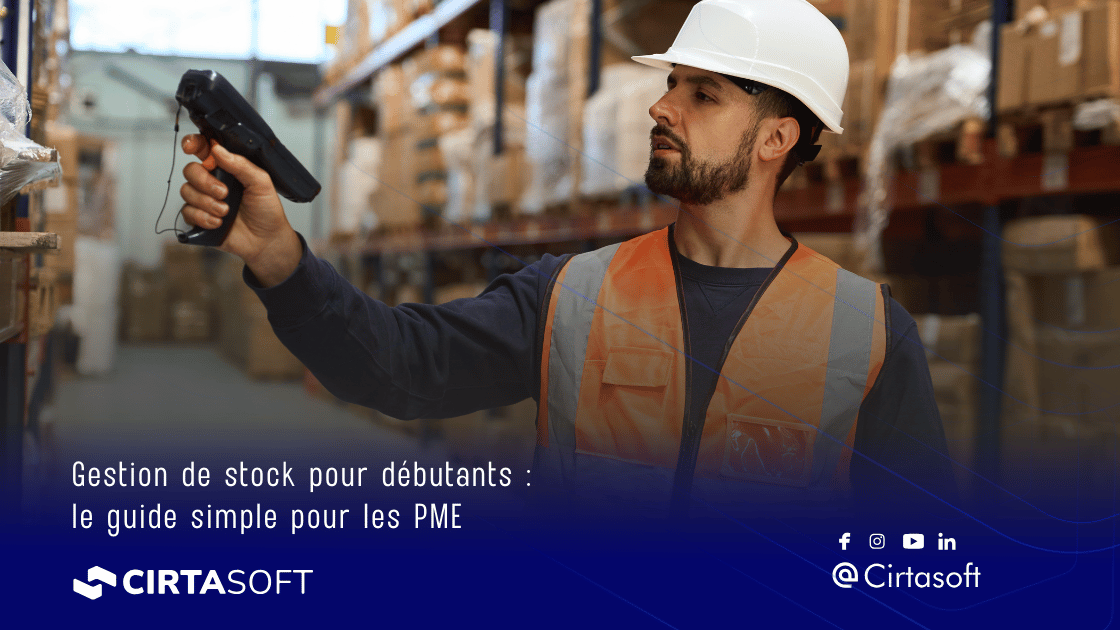
Inventory Management for Beginners: The Simple Guide for SMEs
Inventory management is an essential pillar for any SME, regardless of its sector of activity. Yet many start-up or growing companies consider it a secondary task, often managed in an approximate manner. Poor inventory management can lead to stockouts, costly overstocking, financial losses and customer dissatisfaction. Understanding the basics of inventory management is therefore essential to ensure the stability and profitability of the business.
What is inventory management?
Inventory management involves tracking, organizing and controlling all of a company's products and merchandise, from entry to exit. It allows you to know at any time which items are available, in what quantity and where. The main objective is to have the right product, at the right time, and in the right quantity, without unnecessarily tying up cash flow.
In an SME, inventory management is not limited to counting products. It is closely linked to sales, purchasing, logistics and sometimes even accounting. A clear view of stock allows better decisions to be made and future needs to be anticipated.
Why is inventory management crucial for an SME?
Effective inventory management primarily helps reduce costs. Overstocking ties up capital, takes up space and can lead to losses related to product expiry or obsolescence. Conversely, insufficient stock causes shortages that can drive away customers and damage the company's image.
For an SME, good inventory management also improves responsiveness to the market. The company can respond more quickly to orders, meet delivery deadlines and strengthen customer satisfaction. Finally, good inventory management provides better overall visibility of the business and contributes directly to profitability.
The basics of good inventory management for beginners
The first step is to clearly identify the company's actual needs. It is important to analyze past sales, seasonality and customer demand in order to determine quantities to stock. This approach avoids decisions based solely on intuition.
Next, it is essential to put in place a reliable system to track stock movements. Manual methods quickly become a source of errors as the business grows. A computerized tool allows the stock status to be known in real time and operations to be secured.
Regularity is also a key factor. Periodic stocktakes allow the actual stock to be compared with the theoretical stock and discrepancies to be quickly corrected. This helps detect errors, losses or dysfunctions in internal processes.
Common inventory management methods
Among the most widely used methods, the FIFO principle consists of selling first the products that entered first, which is particularly useful for perishable items. Other companies opt for replenishment based on minimum thresholds to avoid stockouts.
Whatever method is chosen, it must be adapted to the size of the company, its sector of activity and its volume of transactions. The essential thing is to have reliable information to manage stock rationally.
The importance of inventory management software
As the business develops, stock management becomes too complex to be handled effectively without a dedicated tool. Inventory management software automates inflows and outflows, reduces human errors and saves considerable time.
It also offers better visibility through dashboards, movement histories and automatic alerts. These features help managers anticipate needs, optimize purchasing and improve the overall performance of the business.
How GestiumPRO simplifies inventory management for SMEs
GestiumPRO is a commercial and stock management software designed to meet the needs of SMEs and retailers. It provides a clear and precise real-time tracking of stock while remaining simple to use. Stock movements are automatically linked to sales and purchases, avoiding inconsistencies and duplicate entries.
With GestiumPRO, the company can control its stock levels, reduce shortages and better organize its daily operations. It is an ideal solution for businesses that want to professionalize their inventory management without excessive complexity.
GestiumERP: inventory management integrated across the entire business
For companies seeking a global view, GestiumERP goes further by integrating inventory management with all the company's processes. Stock is no longer isolated — it is directly connected to sales, purchasing, invoicing and financial management.
Our ERP provides centralized, reliable and exploitable data for making strategic decisions. Replenishment alerts, analyses and reports help anticipate needs and optimize costs. Inventory management thus becomes a true performance driver rather than a simple operational constraint.
Conclusion
Inventory management is not reserved for large companies. For an SME, mastering its stock is an essential condition for ensuring growth, improving profitability and satisfying customers. By relying on suitable tools such as GestiumPRO or GestiumERP, companies can simplify their processes, reduce risks and effectively manage their activity, even in the start-up phase.